
01273 044556 hello@mitechpro.co.uk

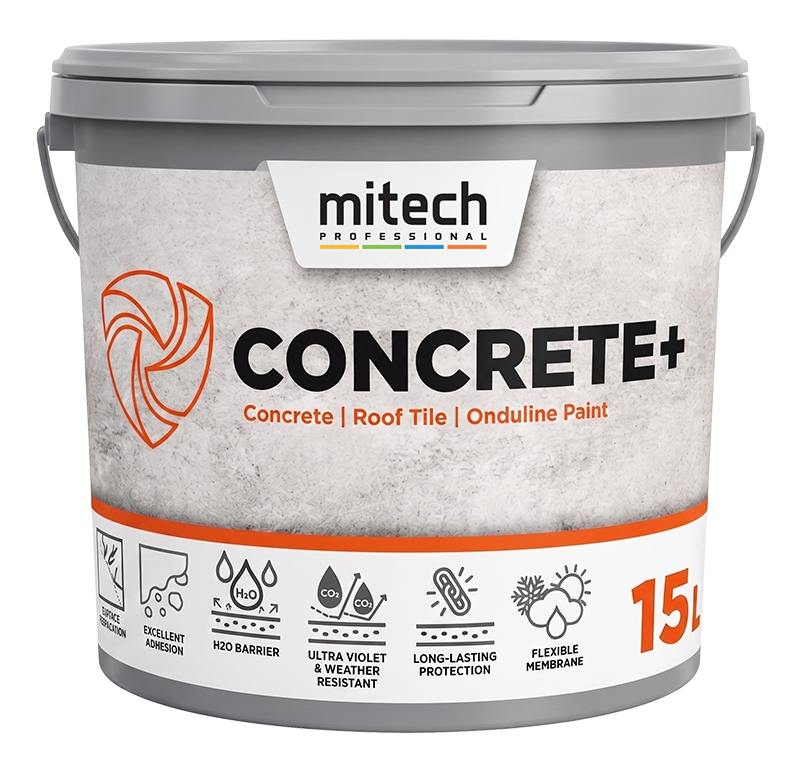
CONCRETE+

Concrete Dispersion Paint

Protect and revitalize your structural surfaces with MITECH CONCRETE+. This advanced concrete dispersion paint forms a resilient, weather-resistant, and water-repellent coating with a beautiful semi-gloss finish. Specially formulated to bridge microcracks and resist abrasion, it prevents erosion by blocking moisture and harmful atmospheric gases (CO_2/SO_2). Available in 12 popular colors, it is the perfect solution for long-lasting structural protection.

£149.00 +VAT

Available in 15l containers

Purpose

CONCRETE+ is used for painting concrete elements. Perfectly suitable for painting vibrated concrete, concrete structures, fiber-cement boards, cement plasters, concrete fences, concrete goods, concrete acoustic screens.

The paint is produced in modern BIO PLUS technology, which highly reduces the development of microorganisms both in the packaging and after application to the substrate. A specially developed mixture of biocidal agents injected under the packaging lid creates a mist that prevents bacterial access to the paint, limiting contamination and microorganism growth.

It forms a colorful coating on the painted substrate with medium gloss, high resistance to weather conditions, and increased resistance to abrasion. It protects against moisture absorption, limits penetration of gases from the atmosphere, and protects concrete against erosion. It can be used on horizontal surfaces with high intensity of precipitation.

Substrate preparation

The substrate should be level, load-bearing, dry, cleaned of release agents, i.e., dirt, dust, fine powder, greasy soil, and bitumens, and free from biological and chemical aggression. Fresh concrete substrates and cement plasters can be painted after a minimum of 28 days of curing. Earlier painting of concrete or cement plasters can be performed after priming the substrate with Mitech FOX equalizing primer (see technical data sheet of the product); concrete moisture content should not exceed 3%.

Fill defects in concrete with Mitech E 45 TIXO cement repair mortar. Smooth out concrete unevenness with Mitech E41 polymer-cement finishing plaster in grey or white color. Prime absorbent substrates with Mitech MG primer. Eliminate biological contamination using Mitech GLOMIX to decontaminate, leave for a minimum of 12 hours, rinse with pressurized water (scattered stream).

In case of heavy fungal infestation, the action can be repeated. Substrates with poor adhesion (detached plasters and paint coatings) should be removed mechanically. If previously covered with distemper or lime paints, they must be cleaned very thoroughly until the proper substrate is exposed. Before painting substrates previously covered with paints, always perform an adhesion test.

How to use

The packaging contains a product ready for use. Directly before use, the entire contents should be very thoroughly mixed using a low-speed mixer/drill with a basket agitator until a uniform consistency is obtained; do not allow the paint to aerate. If necessary, dilute with water as follows: maximum 10% by volume for the first painting, maximum 5% by volume for the second painting. Apply the paint on a properly prepared substrate in two coats using a roller or brush. After applying the first coat, wait for the paint to dry. In optimal conditions (60% relative humidity and $+20^{\circ}C$ air temperature), the drying time is approximately 4 hours. The next coat of paint should be applied only after the previous one has completely dried.

Application recommendations

Pay attention to ensuring the substrate is prepared in an even and careful manner. On new mineral substrates, such as cement plasters and concrete, preparatory work can begin after a minimum of 28 days.

Before starting work, all elements remaining within the work range that are not intended for painting must be appropriately covered and secured. Priming can be performed only on a dried surface, after the binding and hardening period appropriate for a given substrate has elapsed.

After priming the substrate, wait until the applied primer has dried—4 to 24 hours under optimal conditions—and only then proceed to paint application. Dispersion paint is a ready-to-use product, and it is not permissible to add a larger quantity of water to it than specified in the product preparation instructions. Failure to comply with this recommendation may result in changes to the binding properties, color, and paint covering parameters.

Optimal drying conditions are assumed to be a relative humidity of 60% and an air temperature of +20°C. The process of paint preparation, application, and drying should occur at an air temperature from +5°C to +25°C and with stable air humidity. The substrate temperature should be +5°C to +25°C. Low temperature, increased humidity, and rough substrate structure extend the paint's drying time.

Protect newly made paintings from precipitation and low and high temperatures (below +5°C, above +25°C) until bound, for a minimum of 24 hours. The dispersion paint's initial drying time is 24 hours. Complete curing takes 72 hours from applying the last coat.

Implementation possibilities must be appropriately adapted to the surface area intended for painting, taking into account the number of employees, their skills, possessed equipment, the existing condition of the substrate, and prevailing weather conditions.

If it is necessary to take technological breaks during painting, plan invisible locations for them in advance (e.g., in corners, at the junction of colors, behind the gutter, etc.). Painting should be done on surfaces not exposed to direct action of sun, wind, or rain. It is recommended to secure the scaffolding with protective mesh to minimize unfavorable external factors.

Dispersion paint is produced from natural components. To achieve optimal aesthetic quality, execute a facade fragment that constitutes a separate whole in a single technological stage, using material ordered for one-time use and originating from a single production batch. Information and Technical Sheet No: CON-102-2023

The date of production is also the batch designation. To limit color differences, it is recommended to order paint for the entire object; delivery is possible in batches. To avoid visible joints, painting must be done in a continuous technological sequence (using the "wet-on-wet" method) under stable weather conditions. In the autumn-winter and winter-spring periods, the use of MITECH SPW, a paint setting acceleration additive, is recommended (see technical data sheet of the product). After finishing painting works, tightly close the opened paint packaging and use its contents as quickly as possible.

After finishing painting, tools and hands should be washed with running water, bearing in mind that cleaning is difficult after the paint has dried. Wipe freshly soiled elements with a damp cloth. Soiled areas can be washed with MITECH PDC, a stain removal agent.

Available Colours

white

MI 9003

MI 7047

MI 7038

MI 7037

MI 7036

MI 7001

MI 8004

MI 3009

MI 8017

MI 7024

MI 5015

MI 1023

+5°C to +25°C

application temperature

+5°C to +25°C

substrate temperature

60-85%

relative humidity during application and drying

24 hours

drying time

approximately 1.3kg/cdm ± 5%

bulk density

approximately 8

pH

medium gloss (semigloss)

gloss level

E2 >50 <100 µm

coating thickness

S1 Fine <100 µm

grain size

V2 Medium > 0.14 < 1.4m

water vapor transmission coefficient 

W3 Low < 0.1 kg/(m2h0.5)

water permeability

A1 >100 µm

crack bridging

CO No requirements

carbon dioxide permeability

smooth surface: 0.15-0.2 L/m², surface with structure: 0.2-0.4 L/

consumption

24 months, protect from frost and overheating; +5°C +25°C

shelf life; storage temperature

selected RAL colors

colors

MITECH MG deep-penetrating primer; alkaline substrates: MITECH FOX equalizing primer

priming

low-speed mixer with basket agitator, paint roller, brush

tools needed

water

washing tools

10 L, pallet of 44 units, 440 L

packaging

PN-EN 1062:2008; Declaration of Performance No. CON 8151

legal requirements

see safety data sheet

precautions